Trump’s “Donroe Doctrine”: How His Second Term Is Reshaping US Foreign Policy
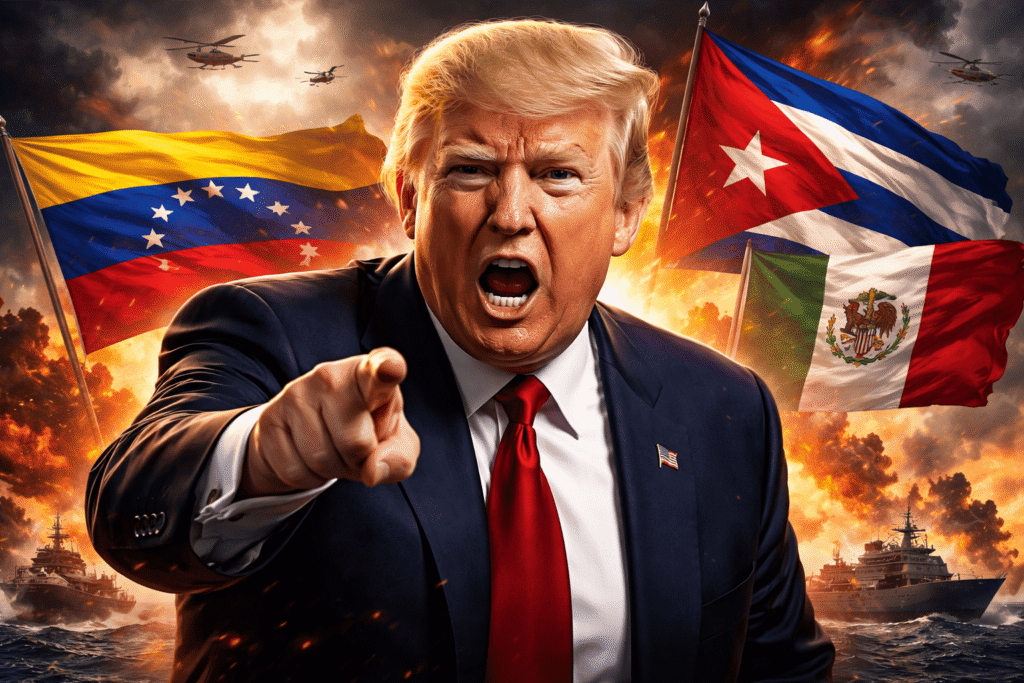
Trump’s Second Term Signals Aggressive Foreign Policy Push Across the Americas and Beyond
US President Donald Trump’s second term is rapidly taking shape through an assertive and confrontational foreign policy, marked by bold rhetoric and dramatic military actions.
In a move that stunned the international community, Trump followed through on long-standing threats against Venezuela, ordering a covert overnight raid in Caracas that resulted in the capture of President Nicolás Maduro and his wife from their heavily fortified residence.
While detailing the operation, Trump revived the 1823 Monroe Doctrine, which historically asserted US dominance in the Western Hemisphere. He rebranded it as the “Donroe Doctrine”, framing it as a renewed warning to governments across Washington’s geopolitical orbit.
In recent days, Trump has issued a series of stark warnings toward several nations, signalling a significant escalation in US foreign policy ambitions.
Greenland: Strategic Arctic Control and Resource Competition
Although the United States already operates Pituffik Space Base in Greenland, Trump has made it clear that he wants full control of the island.
“We need Greenland from the standpoint of national security,” Trump told reporters, claiming the region was increasingly surrounded by Russian and Chinese vessels.
Greenland, an autonomous territory within the Kingdom of Denmark, lies approximately 2,000 miles northeast of the United States. The island holds vast reserves of rare earth minerals, which are essential for smartphones, electric vehicles, and military technologies. At present, China dominates global rare earth production, far surpassing US output.
Its location also provides strategic access to the North Atlantic and the Arctic Circle, areas expected to grow in importance as melting polar ice opens new shipping routes.
Greenland’s Prime Minister Jens Frederik Nielsen firmly rejected Trump’s comments, calling the idea of US annexation a “fantasy” and insisting that any dialogue must respect international law.
Denmark’s Prime Minister Mette Frederiksen later warned that Trump’s statements should be taken seriously, adding that any US military action against a NATO member would bring cooperation to a halt — a position she said had broad European support.
Colombia: Escalating Tensions Over Drugs and Sanctions
Just hours after the Venezuelan operation, Trump turned his attention to Colombia, issuing a blunt warning to President Gustavo Petro.
Colombia, Venezuela’s western neighbour, is rich in oil, coal, and precious minerals, and remains a central hub in the global cocaine trade.
Relations between Washington and Bogotá have deteriorated since September, when the US began striking boats in the Caribbean and eastern Pacific, alleging — without presenting evidence — that they were transporting narcotics.
In October, the US imposed sanctions on Colombia, accusing Petro’s government of allowing drug cartels to thrive.
Speaking aboard Air Force One, Trump described Colombia as being run by “a sick man” involved in cocaine production and suggested US action against the country “sounds good.”
Historically, Colombia has been one of Washington’s closest allies in its war on drugs, receiving hundreds of millions of dollars annually in US military assistance.
Iran: Renewed Threats Amid Protests and Regional Conflict
Trump also issued a warning to Iran, where widespread anti-government protests are ongoing.
He stated that if Iranian authorities resumed killing protesters, the United States would respond forcefully.
Although Iran falls outside the geographic scope of the “Donroe Doctrine,” Trump has repeatedly threatened Tehran following US strikes on Iranian nuclear facilities last year.
Those strikes followed an Israeli military campaign aimed at dismantling Iran’s nuclear weapons capability, culminating in a 12-day Israel-Iran conflict.
At a recent meeting in Mar-a-Lago with Israeli Prime Minister Benjamin Netanyahu, Iran reportedly dominated discussions, with US media suggesting Netanyahu raised the possibility of additional strikes in 2026.
Mexico: Border Security and Cartel Concerns
Trump’s political rise in 2016 was closely tied to his promise to “Build the Wall” along the US-Mexico border.
On his first day back in office in 2025, he signed an executive order renaming the Gulf of Mexico as the “Gulf of America.”
Trump continues to accuse Mexican authorities of failing to curb illegal immigration and drug trafficking, claiming narcotics are “pouring” across the border and describing Mexican cartels as “very strong.”
Mexico’s President Claudia Sheinbaum has publicly ruled out any US military action on Mexican soil.
Cuba: Economic Pressure and Regime Stability
Cuba, located just 90 miles south of Florida, has been under US sanctions since the early 1960s and maintained close ties with Venezuela under Maduro.
Trump suggested military intervention may not be necessary, stating that Cuba appears “ready to fall.”
He noted that the island’s economy has been heavily dependent on Venezuelan oil, which accounts for roughly 30% of Cuba’s supply, leaving Havana vulnerable following political upheaval in Caracas.
US Secretary of State Marco Rubio, whose parents emigrated from Cuba, warned that officials in Havana should be concerned, adding that when the president speaks, his words should be taken seriously.